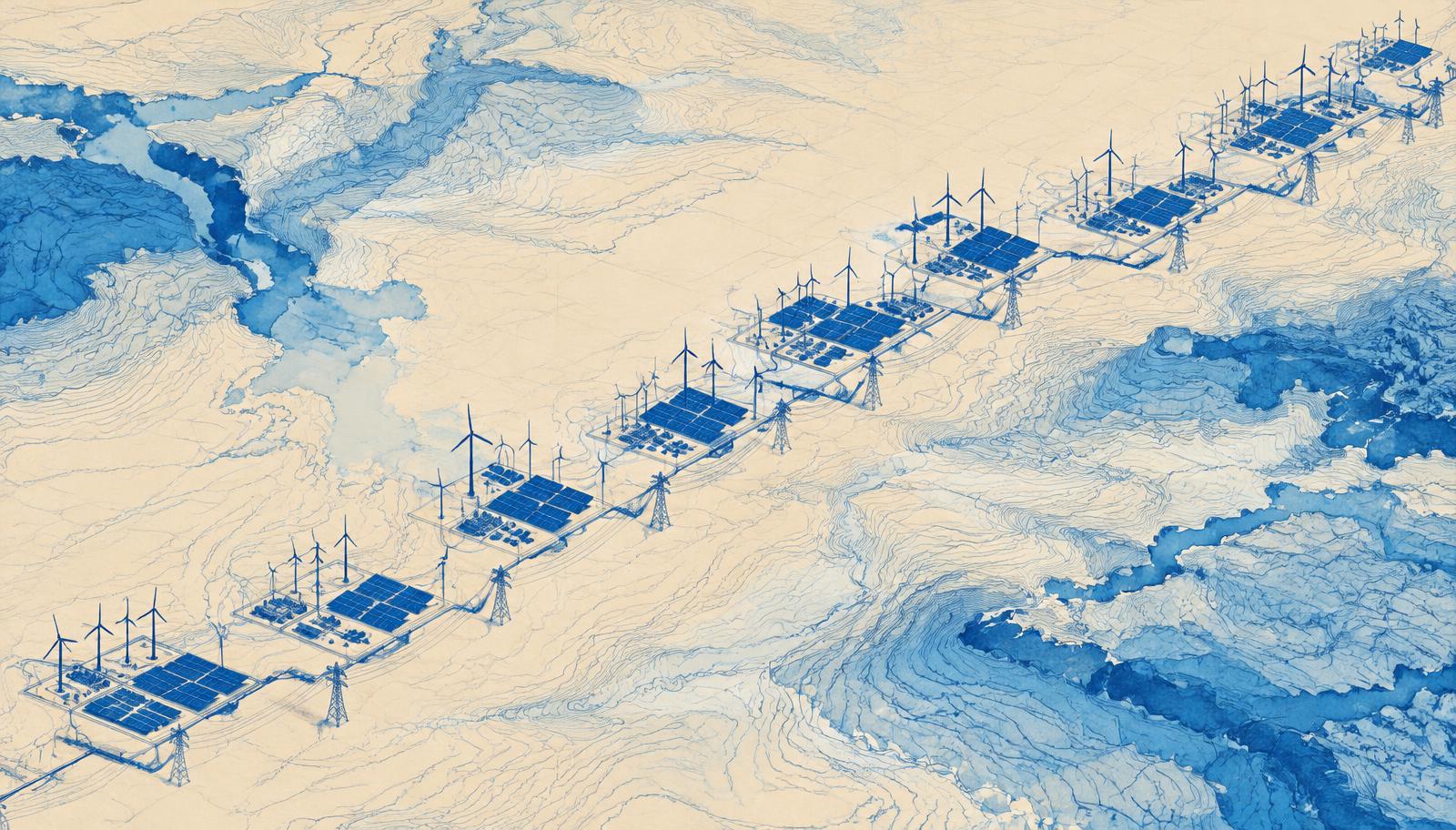
The numbers facing the U.S. power sector are staggering. The massive interconnection queue backlog is the most visible sign of a system under enormous pressure. According to Berkeley Lab's June 2026 "Queued Up" report, over 2,060 gigawatts of generation and storage capacity were actively seeking grid connection at the end of 2025. This backlog is not simply a regulatory hurdle or a technical problem. It is a human capital crisis in the making. While most projects that apply are eventually withdrawn, the report notes that successful projects are taking longer to complete studies and reach commercial operation. This slowdown coincides with record demand growth and an unprecedented build-out of new resources. The result is a hyper-competitive, candidate-driven market for the specialized talent needed to build the grid of the future. For hiring leaders at utilities, IPPs, developers, and data centers, business as usual is no longer an option.
The New Drivers of Demand: Data Centers and Electrification
A decade of flat electricity demand has given way to explosive growth. A primary driver is the proliferation of data centers. The Berkeley Lab United States Data Center Energy Usage Report from June 2026 projects that data centers could consume 11.8% of total U.S. electricity by 2030, with a reference case of 649 TWh. This represents a monumental leap from the 4.4% of U.S. electricity data centers used in 2023, as found in the lab's 2024 report. This new demand is not just large; it is concentrated, relentless, and geographically specific, placing acute stress on local and regional transmission systems. According to Wood Mackenzie, overall U.S. electricity consumption has already risen approximately 7% since 2020, reversing the 1% decline seen from 2010 to 2020. This new load requires new power infrastructure, and more importantly, the people who can plan, permit, engineer, and construct it.
“The massive interconnection queue backlog is a symptom of unprecedented load growth, creating an intense war for talent. Learn what it means for utility hiring.”
The Supply Side Tsunami: Renewables and Storage
Meeting this new demand requires a historic expansion of generation capacity. The U.S. Energy Information Administration (EIA) reports that 53 GW of new capacity was added in 2025, the largest annual addition since 2002. Developers plan to add a record 86 GW more in 2026. This new fleet is dominated by solar, projected to account for 51% of 2026 additions, and battery storage at 28%. Battery storage is growing at a breakneck pace. The EIA notes a record 15 GW of utility-scale battery storage was added in 2025, with another 24 GW planned for 2026. This will bring operational U.S. battery capacity from 43.6 GW at the end of 2025 to nearly 52 GW by mid-2026. Data from Wood Mackenzie and the American Clean Power Association (ACP) shows 18.9 GW of battery storage was installed across all segments in 2025, a 52% increase over 2024. Integrating this wave of intermittent and storage-based resources adds immense complexity to grid operations and planning, demanding a new level of engineering sophistication.
What the Interconnection Queue Backlog Reveals About Talent Gaps
The interconnection queue backlog is a direct reflection of these colliding forces. The bottleneck is not just about physical capacity; it is about the limited availability of specialized human expertise. The fact that projects are taking longer to complete the required feasibility, system impact, and facilities studies points to a severe shortage of the engineers who perform this work. These are not generalist roles. They are highly specific positions like transmission planning engineers, interconnection engineers, protection and control (P&C) engineers, and substation design engineers. The demand for their skills is exploding simultaneously across the entire energy ecosystem. Utilities, independent power producers, renewable developers, and now data center operators are all competing to hire from the same small, finite talent pool. Many developers are building their own in-house interconnection teams to navigate the queue process more effectively, further intensifying the competition for these critical experts.
Competing for Critical Roles: The Engineering Shortage
The war for talent is fiercest for experienced engineers. The Bureau of Labor Statistics (BLS) Occupational Outlook Handbook projects that employment for electrical and electronics engineers will grow 7% from 2024 to 2034, a rate considered much faster than average. This translates to about 17,500 openings per year. More specifically, the BLS projects that jobs for electrical engineers in the electric power generation, transmission, and distribution sector will grow about 13% from 2025 to 2035. Even these numbers may understate the acute need for niche specialists with experience in power flow modeling software, substation design, or relay settings. The median pay for electrical engineers was $111,910 in May 2024 according to the BLS, but compensation for in-demand power systems experts often far exceeds this benchmark. On a macro level, an estimate from Goldman Sachs Research, cited by Exelon's CEO in 2026, suggests the U.S. power sector may need to hire approximately 750,000 additional workers by 2030 to manage the energy transition. This highlights the sheer scale of the staffing challenge ahead.
The Compounding Crises: Supply Chains and Workforce Demographics
Two other factors compound the talent crisis. First, persistent supply chain constraints for critical equipment delay projects and add complexity. A Wood Mackenzie report from August 2025 highlighted supply deficits of 30% for power transformers and 10% for distribution transformers. Demand for power transformers has surged 116% since 2019, with the U.S. importing around 80% of its supply. These shortages create a need for more sophisticated procurement, logistics, and project management expertise to keep projects on track. Second, the industry faces a demographic cliff. The 2023 CEWD/ScottMadden Energy Workforce Survey found that 56% of utility employees have less than 10 years of service. This indicates a significant loss of senior-level institutional knowledge at the exact moment it is most needed for mentoring and navigating complex challenges like NERC CIP compliance. While the survey also showed that emerging-technology jobs grew roughly fourfold between 2021 and 2023, it underscores the frantic race to fill new roles while backfilling for retirements.
Navigating the New Talent Landscape: A Strategic Approach for Employers
To compete and win in this environment, hiring leaders must adopt new strategies. Traditional, slow-moving hiring processes are a severe liability when top candidates receive multiple offers within days. Speed is essential. Flexibility is also non-negotiable. For many in-demand engineering and planning roles, refusing to offer remote or hybrid work options means cutting yourself off from a national talent pool and ceding the best candidates to competitors. Compensation packages must also evolve. Relying on historical salary bands or broad averages is a recipe for failure. Organizations must be prepared to offer aggressive compensation, sign-on bonuses, and robust relocation packages to secure critical hires. Most importantly, hiring must become proactive, not reactive. You cannot afford to simply post a job and hope for the best. Building and maintaining a continuous pipeline of qualified talent is paramount. This requires a deep understanding of the market and a dedicated, continuous recruitment effort, often best achieved through a partnership with a specialized search firm that focuses exclusively on power infrastructure.
The interconnection queue backlog is the clearest signal yet that the energy transition is straining not just our physical grid, but our human capital infrastructure. The competition for engineers, planners, and leaders who can solve these challenges is already intense and will only grow. Utilities, developers, and data center operators that fundamentally transform their approach to talent acquisition will be the ones that succeed in building the reliable, resilient grid of the future. Those that cling to outdated practices will be left struggling to keep the lights on.
GridTal is a retained-only executive and technical search firm dedicated exclusively to U.S. power infrastructure. We partner with utilities, data center power teams, transmission developers, IPPs, and storage innovators to build the teams that are building the future. Our retainer model ensures a dedicated, comprehensive search process, presenting you with only qualified, vetted candidates. If your organization needs to fill a critical leadership or technical role, visit our Request Talent page to begin a conversation. If you are a senior leader or technical expert in the power sector looking for your next challenge, we invite you to submit your Resume confidentially.
Sources
Berkeley Lab "Queued Up" (June 2026 edition, data through end of 2025). Berkeley Lab United States Data Center Energy Usage Report: 2025 Update (June 2026). BLS Occupational Outlook Handbook. EIA. Wood Mackenzie/ACP. Wood Mackenzie (Aug 2025). Goldman Sachs Research (cited by Exelon CEO, 2026). CEWD/ScottMadden 2023 Energy Workforce Survey. NERC CIP standards.
Related reading
See our interconnection recruiting practice and the interconnection manager role guide.